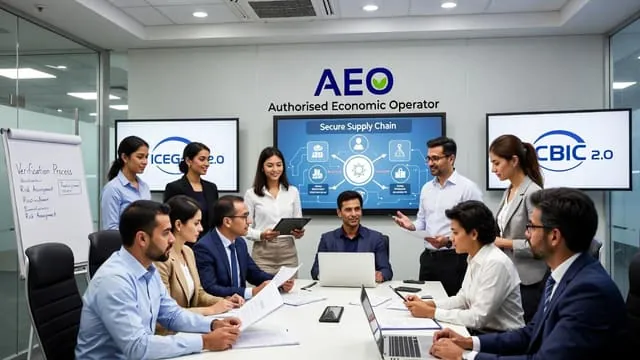
The EMI scheme in Customs lets an approved Eligible Manufacturer Importer take delivery of imported goods without paying duty at the port and pay the whole month's duty, IGST included, by the first day of the next month, with no interest, bond or bank guarantee. It runs from 1 April 2026 to 31 March 2028 as a bridge to AEO-T2 or T3, where the same deferral is permanent. The legal basis is the proviso to Section 47(1) of the Customs Act, which until this year was used only for Authorised Economic Operators; the Union Budget 2026-27 extended it, CBIC created the EMI class by Notification No. 12/2026-Customs (N.T.) of 1 February 2026 and set the conditions in Circular No. 08/2026-Customs of 28 February 2026, and on 3 September 2026 Circular No. 39/2026-Customs cut the application to three documents.
What an EMI gets
An approved EMI files a bill of entry and takes delivery at the port, airport or ICD without paying duty at that point. The duty on all bills of entry filed in a month is then paid on a consolidated basis:
| Bills of entry filed | Duty due |
|---|
| 1st to last day of any month other than March | 1st day of the following month |
| 1st to 31st March | 31st March |
The deferral covers IGST and every other duty assessed on the bill of entry, not only Basic Customs Duty. There is no ceiling on the amount, no interest if payment is made by the due date, and no bond or bank guarantee. Once granted, EMI status applies at every Customs station, so a manufacturer importing through several ports settles one monthly figure. The monthly cycle itself is not an EMI concession: Notification No. 13/2026-Customs (N.T.) amended Rule 4 of the Deferred Payment of Import Duty Rules, 2016 for every eligible importer from 1 March 2026, so AEO-T2 and T3 holders moved from the old fortnightly cycle to the same monthly due date.
Who qualifies
The conditions in Circular 08/2026 are compliance tests, not size tests:
| Condition | Requirement |
|---|
| Status | A manufacturer under Section 2(72) of the CGST Act, or an importer sending inputs or capital goods to job workers under Section 143 of the CGST Act |
| IEC | Valid Importer-Exporter Code |
| Trade record | At least 25 bills of entry or shipping bills in the previous financial year; 10 for MSMEs |
| Turnover | Aggregate turnover above Rs 5 crore in the preceding financial year |
| Continuity | At least two financial years of operation |
| GST | Active registration with manufacturing declared; all GSTR-3B returns filed; no tax collected and unpaid |
| Legacy dues | No unpaid Central Excise or Service Tax dues |
| Solvency | Positive net worth and solvency in the preceding two years, certified by a chartered accountant |
| Record | No arrest or conviction under the Customs, Central Excise, Finance Act or GST laws |
Existing AEO-T1 holders, including MSMEs, may apply if they meet these conditions. The conditions did not change in September; what changed is how much of the proof the applicant uploads and how much the Directorate checks from its own systems.
How to apply: three documents from 15 September 2026
- Apply online on the AEO India portal under the "Eligible Manufacturer Importer" tab. There is no fee. From 15 September 2026 the revised form under Circular 39/2026 asks for three uploads instead of ten: the Udyam certificate where MSME status is claimed, the chartered accountant's certificate on net worth and solvency carrying a UDIN, and the authorisation letter for the signatory. Previous-year import documents, the GST REG-01 manufacturing declaration, GSTR-3B filing status and turnover proofs are no longer uploaded; where goods go to job workers under Section 143, the job workers' GSTINs are still declared.
- The designated officer in the Directorate of International Customs (DIC) scrutinises the application against the Customs and GST systems. On approval the EMI status is updated in the Customs automated system.
- The EMI's nodal person obtains ICEGATE credentials.
- On each bill of entry, select flag "D" (deferred payment). The nodal officer authenticates by OTP through ICEGATE before the goods are released.
- Pay the consolidated duty by the due date under Rule 4 of the Deferred Payment of Import Duty Rules, 2016.
Deferral is chosen consignment by consignment, so an EMI may pay at the port for some bills of entry and defer others in the same month, and may pay early whenever it wishes.
Monitoring and withdrawal
Principal Commissioners and Commissioners see deferred-payment reports on their ICES dashboards and can report non-payment to the DIC, which may suspend or revoke the approval if the EMI ceases to meet a condition. The rules themselves are exact on default: an importer who fails to pay the full duty by the due date more than once in three consecutive months loses the facility, and it is restored only after the duty is paid with interest. The monthly payment must be a diarised treasury event, not an accounts-payable item.
EMI or MOOWR
The other way to hold duty is a Section 65 licence under MOOWR, where the factory itself is a bonded warehouse and duty is paid only when goods are cleared into India, never on what is exported, and never on machinery for as long as it stays in the unit. The price is a licence, a bond, insurance and a per-consignment register. EMI buys about a month; MOOWR buys time without limit and, on exports and capital goods, cancels the duty. A manufacturer selling in India with fast stock turn gets most of the benefit from EMI at almost no compliance cost; one that exports a real share, holds imported stock for months or is importing a large line of machinery should look at the licence.
Why it is time-limited
The circular is explicit that EMI is a transition. The facility is available only until 31 March 2028, by which time CBIC expects approved EMIs to have obtained AEO-T2 or T3 accreditation, where the same deferral is a permanent benefit alongside reduced examination, direct port delivery and faster drawback. The compliance record that makes an EMI application succeed, current GST filings, a certified solvency position and a clean Customs history, is the same foundation an AEO-T2 audit tests.
What it is worth
The cash benefit is modest and should be described honestly: the duty on a month's imports held in the company's own account until the first of the next month, which averages about fifteen days of duty, interest-free, with no collateral. The larger benefit is operational. Once the nodal officer has authenticated, the bill of entry is processed without waiting for the duty payment to clear, which shortens dwell time at the port and removes the payment step from the release chain on every consignment.
Key dates
| Date | Event |
|---|
| 1 February 2026 | Notification No. 12/2026-Customs (N.T.) creates the EMI category; Notification No. 13/2026-Customs (N.T.) moves all eligible importers to a monthly due date |
| 28 February 2026 | Circular No. 08/2026-Customs sets conditions and procedure |
| 1 March 2026 | Applications open on the AEO India portal; monthly cycle applies to AEO-T2 and T3 |
| 1 April 2026 | Scheme operative for approved EMIs |
| 3 September 2026 | Circular No. 39/2026-Customs cuts the application to three documents |
| 15 September 2026 | Revised application form in use |
| 31 March 2028 | Scheme sunsets; EMIs expected to hold AEO-T2 or T3 |
What to do first
- Count last year's bills of entry and shipping bills and confirm the turnover and two-year tests.
- Check the GST filing status and any open Customs, Excise or Service Tax demand before applying; the Directorate reads them from its own systems even though they are no longer uploaded.
- Obtain the chartered accountant's certificate on net worth and solvency for the two preceding years, with UDIN, and the Udyam certificate if MSME status is claimed.
- File on the AEO India portal, and nominate and train the nodal officer who will authenticate each deferred bill of entry.