A Turning Point for GST Enforcement
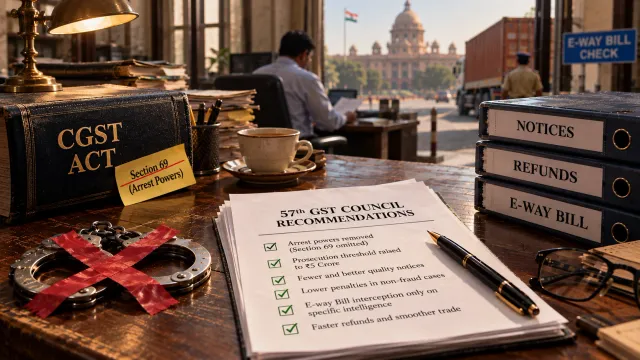
On 8 October 2026, the 57th GST Council recommended the complete withdrawal of arrest powers under GST by omitting Section 69 of the CGST Act, 2017. Nine years after GST was launched, the tax officer will no longer be able to take a taxpayer into custody on his own authority.
The arrest decision is part of a wider package. The Council also recommended:
- raising the monetary threshold for prosecution from ₹1 crore to ₹5 crore;
- omitting clause (i) of Section 132(1), deleting the words "evades tax" from clause (e) and narrowing clause (h);
- removing the minimum imprisonment of six months and giving courts discretion to impose only a fine;
- reducing the general penalty from ₹25,000 to ₹10,000.
Significantly, the Council placed these measures under "Ease of living and doing business", not under anti-evasion. That label tells us how the government now views the arrest power: as a cost to commerce and to individual liberty, not merely as an enforcement tool.
A word of caution at the outset. A Council recommendation does not by itself amend the law. Parliament and the State legislatures must amend the CGST and SGST Acts, and the transitional provisions will decide what happens to pending investigations, unexecuted arrest authorisations and cases already in court. The government is expected to bring the amendments in the Winter Session of Parliament.
As a former officer of the Indian Revenue Service who has watched GST enforcement from both sides of the table, I believe this is the right decision. But it deserves to be examined honestly, from both angles.
The Arrest Record Since 2017
On the published figures, central GST formations alone have made well over 1,700 arrests since July 2017, and the true total is higher once State GST arrests are added. No single consolidated national figure has been released; the table below brings together what the government has disclosed in Parliament and before the Supreme Court.
| Period | Persons arrested | Context | Source |
|---|
| FY 2025-26 | 358 | ITC fraud cases only: 30,162 cases, ₹74,782 crore detected (CGST) | Rajya Sabha reply, July 2026 |
| FY 2024-25 | 178 | ITC fraud cases only: 15,283 cases, ₹58,773 crore | Rajya Sabha reply |
| FY 2023-24 | 182 | ITC fraud cases only: 9,190 cases, ₹36,373 crore | Rajya Sabha reply |
| FY 2021-22 to FY 2024-25 | 887 | All GST cases, central formations only: 72,393 cases registered | Business Today, Oct 2026 |
| FY 2021-22 to FY 2024-25 (Gujarat) | 101 | 12,803 evasion cases booked by central officers | Rajya Sabha reply, Dec 2024 |
| May 2023 drive (to Jan 2024) | 121 | 29,273 bogus firms, ₹44,015 crore suspected ITC evasion | Lok Sabha reply, Feb 2024 |
| July 2017 to Oct 2022 | 960 | Cumulative CBIC arrests, including 20 chartered accountants | Press report, Oct 2022 |
| Nov 2020 to Nov 2022 | 719 | Special drive: ₹55,575 crore fake ITC; 20 CA/CS professionals | Official statement |
| FY 2020-21 | 460 | Peak year: ₹49,384 crore evasion detected, ₹12,235 crore recovered | Rajya Sabha reply, Dec 2023 |
| FY 2017-18 | 3 | First year of GST | Data before the Supreme Court |
Some rows overlap and the FY 2023-24 to FY 2025-26 figures cover ITC fraud alone, so the rows should not be added together. Even so, 960 arrests up to October 2022 plus 718 ITC-fraud arrests in the last three years gives a floor of about 1,700.
Three features of this record stand out.
Arrests have outrun convictions. In July 2025 the Punjab and Haryana High Court noted that only one conviction had been secured in Punjab, Haryana and Chandigarh since GST began. It observed that arrests were usually made without prior notice under Sections 73 or 74, while cases where notices were served rarely saw arrests.
Arrests have not produced recoveries. In the peak year 2020-21, recovery was about a quarter of the evasion detected. In Kerala, 14 arrests in high-value cases since 2021 did not lead to a single chargesheet.
The courts had to step in. In Radhika Agarwal v. Union of India (2025), a three-judge bench of the Supreme Court upheld the arrest power but tied it to strict safeguards: recorded reasons based on evidence, prompt production before a magistrate, and a clear statement that using the threat of arrest to extract tax payments is unlawful.
Impact on Tax Generation: Compliance Without Fear
The strongest case for the reform is that GST revenue is driven by voluntary compliance, not by custody. Gross GST collections reached about ₹22.27 lakh crore in 2025-26, almost all of it self-assessed and paid by honest businesses. A law should be designed for those who pay, not only for the few who cheat.
Fear distorts behaviour. In my experience, the threat of arrest rarely brings out a true return. It brings out a payment "under protest" during a search, made to avoid custody rather than because tax is due. Such payments later turn into litigation and refund claims. Industry bodies have complained that arrest was used as a lever to push firms into paying disputed demands rather than contesting them. Revenue collected this way is neither stable nor fair.
Honest disputes will be settled on merit. Most GST disputes are about classification, valuation, place of supply or eligibility of credit. These are questions of interpretation, not crime. Once the shadow of arrest is lifted, businesses can argue the law openly before adjudicating authorities, and officers will have to win on evidence. That improves the quality of demands and, over time, the share of demands actually realised.
More businesses will come into the net. Small traders and MSMEs often stay outside GST, or under-report, partly because they fear the department. A regime that punishes fraud through courts but treats errors as civil matters lowers that barrier. Wider registration and cleaner returns mean a broader base, which matters more for revenue than a handful of arrests.
Professionals and executives can do their jobs. Arrests of chartered accountants and senior corporate executives created a chilling effect across the advisory profession and among investors. Removing that risk supports the government's wider push for investment and ease of doing business.
The direction is consistent across taxes. Pre-GST VAT laws had no administrative arrest power for tax officers. In September 2026 the CBDT also removed "arrest and detention" from the income-tax recovery rules. The GST change brings indirect tax in line with that thinking.
Alongside lower penalties, faster refunds and simpler registration recommended in the same meeting, the removal of arrest should improve working capital and confidence. That is the soil in which steady tax growth takes root.
The Other Side: Will Fraud Flourish Without Fear?
The concern is real and must not be brushed aside. GST fraud is not shrinking; it is growing. Fake ITC detected by central officers rose from ₹36,373 crore in 2023-24 to ₹74,782 crore in 2025-26, and the number of cases more than tripled. Those who oppose the change make the following points.
- Fraud syndicates are organised criminals, not taxpayers. Fake invoice rings run dozens of shell firms on forged PAN and Aadhaar, mule bank accounts and dummy directors. One recent case involved 66 shell proprietorships in a ₹177 crore racket. For such operators, a civil demand against a non-existent firm is meaningless.
- Masterminds abscond. Even with arrest powers, the government reported 14, 2 and 7 masterminds absconding in fake-registration cases over the last three years. Without the power to detain at the point of detection, more may disappear, and evidence and money may vanish with them.
- Custodial interrogation helps unravel chains. Fake ITC passes through many layers. Investigators argue that a short period of custody is often the only way to reach the beneficiary at the end of the chain.
- Deterrence works at the margin. A ₹5 crore threshold for prosecution, the removal of minimum imprisonment and lower penalties together may signal to a fraudster that the worst outcome is a fine.
- Revenue may leak in the transition. Until the new framework settles, syndicates may test the limits, and pending investigations may be disrupted.
These arguments carry weight, particularly for the hard core of fake-invoice fraud. The question is not whether that fraud must be punished. It must. The question is whether arrest by a tax officer is the only effective tool, and whether its cost to honest trade is worth paying.
Why the Fraud Risk Is Manageable
On balance, the fear that fraud will run free is overstated, because the removal of Section 69 does not remove the State's ability to catch and punish fraudsters. It changes who arrests and on what basis.
Criminal law still applies. Prosecution under Section 132 remains for serious offences above the new threshold, and a court can still issue warrants and send a convicted person to prison. Fraud involving forged identities, fake firms and cheating can be pursued through the police under the Bharatiya Nyaya Sanhita, which is how the pre-GST VAT regime handled it. The removal of Section 69 is not immunity from arrest under other laws.
Technology now does what custody once did. Biometric Aadhaar authentication for new registrations and mandatory sequential filing of GSTR-1 were introduced specifically to choke fake registrations. E-invoicing, e-way bills and data analytics let DGGI trace an invoice chain without first detaining anyone. Fake registrations using forged documents have already fallen from 5,699 in 2023-24 to 1,517 in 2025-26.
Money can be stopped without custody. The department retains powers to block ITC under Rule 86A, provisionally attach property and bank accounts under Section 83, cancel registrations and raise demands with full penalty. In the 2023 drive against bogus firms, most of the revenue protected came from blocking credit, not from arrests: ₹997 crore of ₹1,317 crore.
Arrest was never the real deterrent. Deterrence comes from the certainty of conviction, not from a night in custody. A record of hundreds of arrests a year with very few convictions has deterred neither fraudsters nor protected honest traders. Freeing officers from arrest-led investigations lets them build cases that end in conviction.
To make the transition safe, I would suggest a few safeguards:
- Notify special GST courts with time limits for trial of fake-invoice cases.
- Set up a formal protocol with State police for quick FIRs in identity-fraud and syndicate cases.
- Allow the department to seek a magistrate's warrant against proven absconders.
- Draft clear transitional provisions so pending investigations are not derailed.
The GST Council's decision is a sound and mature one, and it deserves the support of trade and administration alike. For nine years, the arrest power produced well over 1,700 arrests, very few convictions and a deep sense of fear among honest businesses, while fake-invoice fraud kept growing. Clearly, custody was not the answer.
The risk of fraud is real, but the tools to fight it have changed. Biometric registration, e-invoicing, data analytics, credit blocking, attachment and prosecution through the courts give the State more reach today than an arrest warrant ever did. What GST needs is fewer arrests and more convictions.
For Indian trade, the message is clear. The tax system now presumes that a taxpayer is honest until proven otherwise, and reserves the criminal process for proven fraud, decided by a court. That trust must be repaid with compliance. If it is, the result will be a wider tax base, fewer disputes and stronger revenue, earned without fear.