
| Key Takeaways |
| Status: Signed on April 27, 2026 — awaiting domestic ratification in both countries before entry into force. |
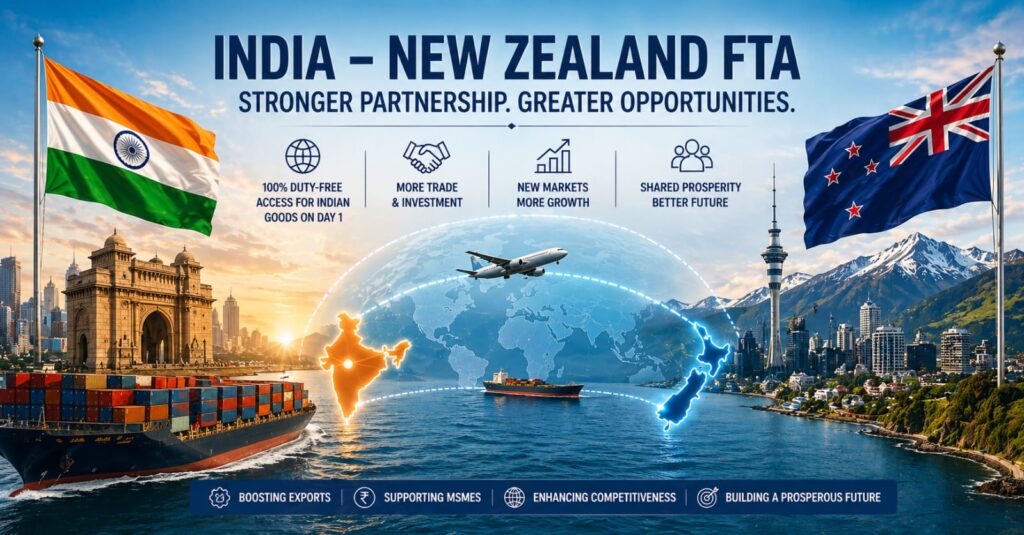
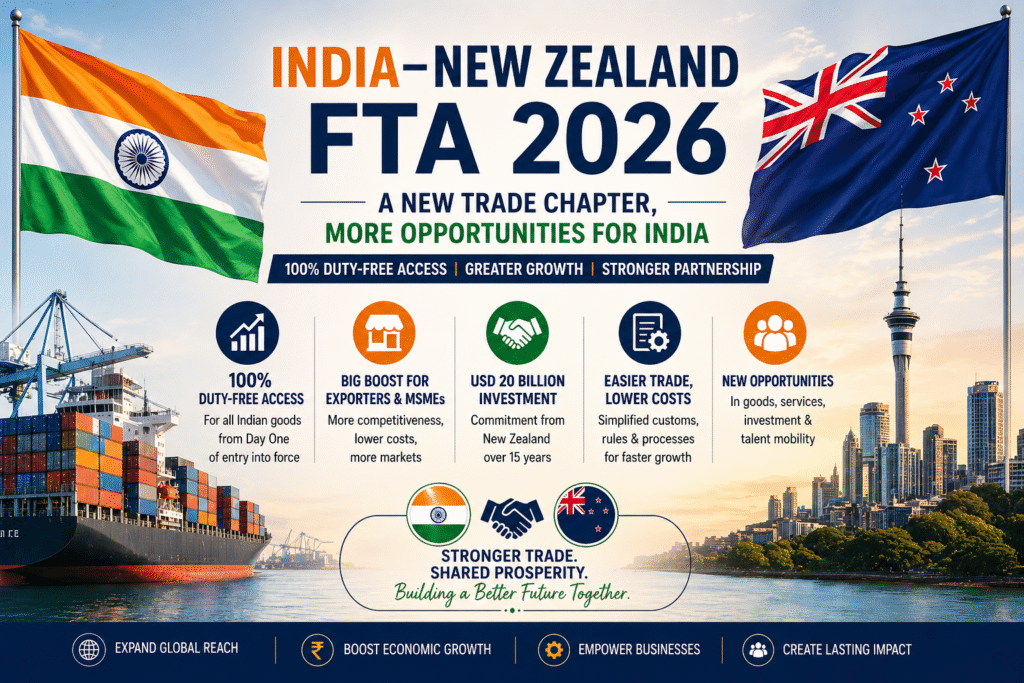
| Coverage: 100% duty-free access to New Zealand for all Indian goods on Day 1 of entry into force. |
| Sensitive Sectors Protected: Dairy, key agricultural products (onions, sugar, edible oils), gems & jewellery kept in exclusion list. |
| India’s Offer: Tariff liberalisation on 70% of tariff lines covering 95% of bilateral trade value. |
| Investment: USD 20 billion commitment from New Zealand over 15 years, with a dedicated ‘NZ Investment Desk’ in India. |
| Speed: Concluded in nine months — one of India’s fastest FTAs with a developed economy. |
India signed its Free Trade Agreement with New Zealand on April 27, 2026 — and it is not a routine trade pact. Concluded in just nine months from the launch of negotiations in March 2025, this agreement signals India’s accelerating pace of global trade diplomacy. Union Minister Shri Piyush Goyal and New Zealand’s Minister for Trade and Investment Hon. Todd McClay signed the agreement at Bharat Mandapam, New Delhi, in the presence of businesses and cross-party delegations from both sides.
For Indian exporters, MSMEs, manufacturers, professionals, and students — this FTA opens a new front in India’s engagement with the developed world. At Trade Bridge Advisors, we have reviewed both countries’ official summaries and break down what this agreement actually delivers, sector by sector.
The Strategic Context: Why New Zealand Matters for India
New Zealand may be geographically distant, but it sits at a strategically useful node in the Indo-Pacific. India is New Zealand’s fastest-growing trade partner, and with bilateral merchandise trade already growing 49% in FY 2024-25 to reach approximately USD 1.3 billion, the FTA builds on genuine commercial momentum — not just diplomatic optics.
This is India’s ninth FTA with 38 developed countries, covering nearly 65-70% of global GDP. New Zealand becomes a gateway that Indian exporters can use to deepen their presence across the broader Indo-Pacific regional trade ecosystem — particularly as India eyes agreements with the EU and the United States.
What India Gets: Goods Access
100% Duty-Free Access — Day One
The headline outcome for India is straightforward: New Zealand will eliminate tariffs on 100% of Indian exports on the very day the agreement enters into force. This is unprecedented — and it includes sectors where New Zealand previously maintained peak tariffs of up to 10%.
Key beneficiaries include:
- Textiles, apparel, and home furnishings
- Leather and footwear
- Gems and jewellery
- Engineering goods, machinery, and auto components
- Processed foods including fruits, spices, cereals, coffee, and cocoa
- Pharmaceuticals and medical devices
- Chemicals, plastics, rubber, and electronics
Duty-Free Inputs for Indian Manufacturing
India also secures duty-free imports of key manufacturing inputs from New Zealand — wooden logs, coking coal, and waste and scraps of metals. This directly lowers production costs for Indian industries and strengthens their global competitiveness.
Pharma Fast-Track: A Genuine Breakthrough
For India’s pharmaceutical and medical devices sector — one of its most globally competitive — the FTA provides a significant regulatory win. New Zealand will accept GMP and GCP inspection reports from comparable regulators (US FDA, EMA, UK MHRA, Health Canada). This eliminates duplicative inspections, reduces compliance costs, and speeds up product approvals for Indian pharma exporters entering the New Zealand market.
What India Offered: A Calibrated, Sensitive Approach
India has offered tariff liberalisation on 70.03% of tariff lines, covering 95% of bilateral trade value — while keeping 29.97% of tariff lines in exclusion to protect domestic sensitivities.
| Liberalisation Category | Coverage |
| Immediate duty elimination (Day 1) | 30% of tariff lines — wood, wool, sheepmeat, raw hides, coal |
| Phased elimination (3, 5, 7, 10 years) | 35.6% of tariffs — petroleum oil, malt extract, vegetable oils, select machinery |
| Tariff reductions (not full elimination) | 4.37% — wine, pharma drugs, polymers, aluminium, iron & steel articles |
| Tariff Rate Quotas (TRQs) | 0.06% — Manuka honey, apples, kiwifruit, albumins |
| Exclusions (no access) | 29.97% of tariff lines — see protected sectors below |
Protected Sectors — What India Kept Out
India has firmly protected sensitive domestic sectors. The exclusion list includes:
- Dairy: milk, cream, whey, yoghurt, cheese, and all dairy products
- Key agricultural commodities: onions, chana, peas, corn, almonds, coffee
- Sugar and artificial honey
- Animal, vegetable, and microbial fats and oils
- Gems and jewellery (in exclusion as an import category)
- Copper and aluminium articles
- Arms and ammunition
This exclusion architecture reflects India’s standard template — protecting farmers, rural economies, and domestic industry while offering substantive access on manufactured and processed goods.
Agricultural TRQs: Apples, Kiwifruit, and Manuka Honey
The three agricultural TRQs in the agreement deserve close attention — they come with Minimum Import Prices (MIPs), seasonal windows, and a Joint Agriculture Productivity Council (JAPC) that will monitor delivery against Agricultural Productivity Action Plans.
| Product | Key TRQ Terms |
| Apples (50% current duty) | 32,500 MT (Year 1) rising to 45,000 MT (Year 6) at 25% duty; MIP USD 1.25/kg; seasonal window April 1 – August 31 |
| Kiwifruit (33% current duty) | 6,250 MT (Year 1) rising to 15,000 MT (Year 6) at 0% duty; MIP USD 1.80/kg; seasonal window April 1 – October 15 |
| Manuka Honey (66% current duty) | 200 MT p.a. in-quota at 75% tariff reduction over 5 years; MIP USD 20/kg in-quota, USD 30/kg out-of-quota |
| Albumins / Milk Albumin (22% duty) | 1,000 MT (Year 1) rising to 3,000 MT (Year 5) at 11% duty |
Importantly, India has secured a consultation clause on dairy: if India offers dairy access to any comparable economy in the future, it will consult with New Zealand on extending similar treatment. This is not a concession — it is a holding position that keeps India’s options open while ringfencing the domestic sector.
Fast-Track Mechanism for Export Manufacturing
A provision that SEZ and EOU operators will want to note: the FTA establishes a dedicated fast-track arrangement allowing Indian businesses to import ingredients from New Zealand duty-free for manufacture of products for export. This is the first time India has made such a commitment in any FTA.
For SEZ units and EOUs sourcing agricultural inputs from New Zealand for processing and re-export, this mechanism creates a genuine supply chain advantage. Trade Bridge Advisors can assist your unit in structuring operations to capture these benefits efficiently.
Services: Best-Ever Offer by New Zealand
New Zealand has opened market access across 118 services sectors — including Computer Related Services, Professional Services, Telecommunications, Construction, Education, Environmental Services, Financial Services, and Tourism. Most-Favoured Nation (MFN) commitments have been made in 139 sub-sectors.
Critically, New Zealand’s services commitments are future-proofed: any better access extended to any other FTA partner is automatically extended to India. This is a durable, competitive advantage for Indian services exporters.
Talent Mobility: Real Pathways for Indian Professionals
Temporary Employment Entry (TEE) Visas
A new TEE Visa pathway provides a quota of 5,000 visas at any given time, valid for up to three years. Covered professions span two distinct categories:
- High-demand skilled sectors: IT, engineering, healthcare, education, construction
- Iconic Indian professions: AYUSH practitioners, yoga instructors, Indian chefs, music teachers
Student Pathways — No Numerical Caps
For the first time with any country, New Zealand has created a dedicated Student Mobility and Post-Study Work Visa pathway with India, with no numerical caps on Indian students. Key features:
- Guaranteed minimum 20 hours per week work during study
- Post-study work up to 3 years for STEM Bachelor’s and Master’s graduates
- Post-study work up to 4 years for Doctoral scholars
- 1,000 Working Holiday Visas annually for young Indians aged 18-30
Investment: USD 20 Billion Commitment
New Zealand has committed to facilitating USD 20 billion in private sector investment into India over 15 years, targeting agriculture, manufacturing, infrastructure, start-ups, and emerging technologies. A dedicated ‘New Zealand Investment Desk’ will be established to assist NZ investors navigating India’s regulatory landscape across the investment lifecycle.
The agreement also incorporates a Rebalancing Clause — a mechanism to address shortfalls in investment delivery, ensuring the commitment is not merely aspirational.
Customs Procedures and Trade Facilitation
From a customs practitioner’s perspective, the trade facilitation chapter contains meaningful commitments:
- Standard cargo clearance within 48 hours; perishable goods and express consignments within 24 hours
- Electronic submission of import documentation to India Customs codified in the FTA
- Advance Ruling access and procedures embedded in the agreement
- Single Window for customs clearance import procedures formalised
- Authorised Economic Operator (AEO) recognition incorporated
- Choice of proof of origin: Certificate of Origin or self-declaration for approved exporters
These provisions reduce uncertainty and transaction costs for Indian exporters shipping to New Zealand — and align with India’s broader push toward paperless, technology-driven border management.
Rules of Origin: Protecting Genuine Indian Exporters
The FTA establishes Product Specific Rules of Origin (PSRs) designed to ensure substantial transformation within Indian territory — preventing circumvention, misuse, or falsification of origin criteria. The framework includes non-qualifying operations provisions and a comprehensive, time-bound verification mechanism with provisions for denial and temporary suspension of preferential treatment.
For exporters claiming FTA benefits, maintaining robust documentation and traceability across the supply chain will be essential. Trade Bridge Advisors can assist in conducting origin audits and setting up compliance systems before the agreement enters into force.
Intellectual Property: GI Protections for Indian Products
Currently, New Zealand’s GI law only permits registration of wines and spirits. Under the FTA, New Zealand has committed to amending its domestic GI legislation within 18 months of entry into force to enable registration of ‘other goods’ — bringing India on par with treatment extended to the European Union. This opens formal protection pathways for iconic Indian GIs in the New Zealand market.
AYUSH and Traditional Knowledge: A First in FTAs
For the first time in any of its trade agreements, New Zealand has included a dedicated Health and Traditional Medicine Services access chapter. This promotes India’s AYUSH systems globally — Ayurveda, Yoga, Unani, Sowa-Rigpa, Siddha, and Homeopathy — supports medical value travel, and reinforces India’s position as a global hub for wellness and traditional medicine services.
What This Means — State by State
The PIB press release highlights the geographic spread of expected gains across Indian states:
- Gujarat: Chemicals and gems
- Maharashtra: Pharmaceuticals and auto components
- Tamil Nadu: Textiles, leather, and auto components
- Uttar Pradesh: Leather, carpets, and handicrafts
- Punjab: Agricultural products
- Karnataka: Pharma and electronics
- West Bengal: Tea and engineering goods
- Andhra Pradesh & Kerala: Marine exports
- North-East India: Tea, spices, bamboo, and organic produce
What Should Businesses Do Now?
The FTA is signed but not yet in force — ratification in both countries is pending. This window is precisely when preparation pays off. Here is what Indian businesses should be doing:
| Action | Who Should Act |
| Classify your goods under the FTA tariff schedule and assess duty savings | All exporters and importers |
| Assess Rules of Origin compliance and document supply chains | Manufacturers and exporters claiming preferential treatment |
| Evaluate fast-track input sourcing from NZ for export manufacturing | SEZ units, EOUs, and EOUs in food processing |
| Review services sector commitments and MFN provisions | IT, fintech, education, and professional services firms |
| Explore TEE Visa pathways for talent deployment to New Zealand | IT companies, healthcare, engineering, and AYUSH practitioners |
| Assess GI registration opportunities in New Zealand post-amendment | GI-tagged product producers and industry bodies |
| Structure investment proposals aligned with USD 20 billion commitment | Infrastructure, renewable energy, and agri-tech firms |
| How Trade Bridge Advisors Can Help |
| Navigating a new FTA requires more than reading the summary. It demands origin structuring, tariff mapping, compliance readiness, and strategic positioning before the agreement enters into force. |
| At Trade Bridge Advisors, we bring decades of regulatory expertise across SEZ, EOU, FTWZ, DGFT, and Customs frameworks to help you capture FTA benefits — not just on paper, but in practice. |
| Contact us at info@tradebridgeadvisors.com | +91 961-910-2025 | tradebridgeadvisors.com |