
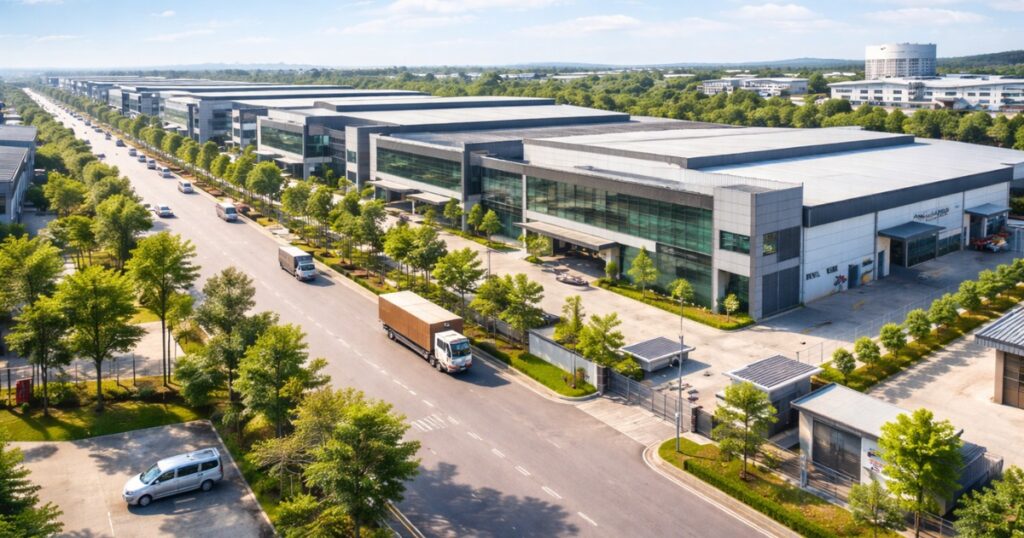
On March 18, 2026, the Union Cabinet, chaired by Prime Minister Shri Narendra Modi, approved the Bharat Audyogik Vikas Yojna — or BHAVYA — with a total financial outlay of ₹33,660 crore. The scheme envisions the creation of 100 plug-and-play industrial parks across the country — world-class, future-ready ecosystems that allow businesses to move from investment intent to actual production with unprecedented speed and certainty.
For manufacturers, MSMEs, startups, and global investors who have long lamented India’s infrastructure bottlenecks, lengthy approval timelines, and fragmented industrial land markets — BHAVYA is a direct policy answer.
“At the heart of BHAVYA is a commitment to ease of doing business.” — Information and Broadcasting Minister Ashwini Vaishnaw
Let us unpack what BHAVYA is, who it benefits, how it works, and — most importantly — what it means for your business.
What is BHAVYA Scheme in India?
BHAVYA stands for Bharat Audyogik Vikas Yojna. It is a flagship central government scheme under the Department for Promotion of Industry and Internal Trade (DPIIT), Ministry of Commerce and Industry. It will be implemented by the National Industrial Corridor Development Corporation (NICDC) — the same body that has already been successfully overseeing 20 industrial smart city projects in 13 states.
The BHAVYA Scheme in India (2026) is one of the most significant industrial policy initiatives aimed at boosting manufacturing and exports.
BHAVYA builds upon and expands the successful National Industrial Corridor Development Programme (NICDP) model, taking India’s industrial infrastructure ambition to the next level. The scheme will run over six years starting from 2026–27, with approximately 50 parks targeted in the first phase.
BHAVYA Scheme Key Highlights & Financial Outlay
| Parameter | Detail |
| Total Financial Outlay | ₹33,660 Crore |
| Number of Industrial Parks | 100 Plug-and-Play Parks |
| Total Area Targeted | ~33,600 Acres |
| Park Size Range | 100 to 1,000 Acres (25 Acres for hilly/NE states) |
| Central Assistance (Core Infra) | Up to ₹1 Crore per Acre |
| External Connectivity Support | Up to 25% of Project Cost |
| Employment Target (Direct) | ~15 Lakh Jobs |
| Implementation Timeline | 6 Years (FY 2026-27 onwards) |
| Implementing Agency | NICDC, under DPIIT |
BHAVYA Scheme Plug-and-Play Industrial Parks Explained
Historically, setting up a manufacturing unit in India involved years of navigating land acquisition, environmental clearances, utility connections, and infrastructure setup — all before a single machine was switched on. BHAVYA is designed to eliminate this painful pre-production phase entirely.
Under BHAVYA, industrial parks will be developed as complete, ready-to-use ecosystems. When a business enters a BHAVYA-approved park, the following will already be in place:
Core Infrastructure
- Internal roads and transport corridors
- Underground utility corridors (power, water, gas) — enabling a no-dig environment
- Drainage systems and Common Effluent Treatment Plants (CETPs)
- High-speed digital connectivity (ICT systems)
Value-Added Infrastructure
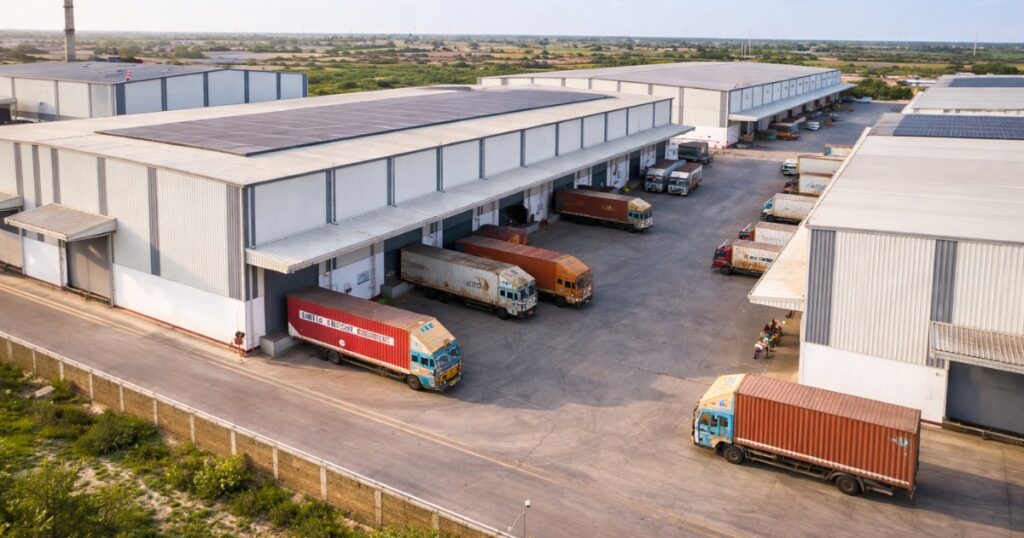
- Pre-built factory sheds ready for immediate occupation
- Testing and certification laboratories
- Warehousing and logistics facilities
Social & Worker Infrastructure
- Worker housing and residential amenities
- Commercial and social support services
External Connectivity
- Seamless links to highways, railways, and ports
- Alignment with PM GatiShakti multimodal connectivity principles
- Green energy solutions and sustainable resource management
In essence, a business can simply ‘plug in’ and begin manufacturing — bypassing months of bureaucratic delay and capital blockage. This is the plug-and-play model in its most literal sense.
Who Can Benefit from BHAVYA Scheme in India? The Breadth of BHAVYA’s Reach
BHAVYA is explicitly sector-agnostic — it is open to businesses across all industries. The scheme identifies both primary and secondary beneficiaries:
scheme identifies both primary and secondary beneficiaries:
| Primary Beneficiaries ✅ | Secondary Beneficiaries ✅ |
| Large manufacturing units | Workers & skilled labour |
| MSMEs seeking ready infrastructure | Logistics and transport providers |
| Startups reducing fixed-cost burden | Service sector enterprises |
| Global investors seeking speed-to-market | Local communities near industrial parks |
The scheme is particularly significant for MSMEs and startups — segments that have traditionally been priced out of premium industrial land due to high upfront infrastructure costs. BHAVYA dramatically lowers the threshold for entry. This makes the BHAVYA Scheme in India highly attractive for both domestic businesses and global investors.
How BHAVYA Scheme Industrial Parks Are Selected? The Challenge Mode Mechanism
One of the most progressive and governance-focused elements of BHAVYA is its project selection model — the ‘Challenge Mode.’ Rather than a top-down allocation, states will compete for central funding by submitting proposals that demonstrate:
- Investment-readiness and ease of doing business reforms
- Effective single-window clearance systems
- Transparent and bankable land allocation policies
- Access to transport links, ports, and a skilled workforce
- Proximity to existing industrial clusters and value chains
This promotes competitive federalism — states that implement genuine reforms will attract more BHAVYA parks and, consequently, more investment. It is a powerful incentive for state governments to accelerate their business environment improvements.
Each selected project will be managed by a dedicated Special Purpose Vehicle (SPV) with statutory planning and single-window clearance powers — ensuring accountability and execution discipline.
BHAVYA Scheme and India’s Industrial Policy Ecosystem
BHAVYA does not exist in isolation. It is a carefully positioned complement to several other key policy planks:
| Policy / Scheme | How BHAVYA Connects |
| PLI Schemes | Provides the physical infrastructure where PLI-backed production can be rapidly scaled |
| PM GatiShakti | Industrial parks will be aligned for multimodal connectivity under GatiShakti |
| NICDP (Industrial Smart Cities) | BHAVYA expands and builds on this proven model, deepening its geographic reach |
| Atmanirbhar Bharat | Strengthens domestic manufacturing and reduces import dependency |
| Viksit Bharat 2047 | Drives manufacturing-led growth, employment, and export competitiveness |
| India-EU FTA (concluded Jan 2026) | Ready industrial parks position Indian exporters to capture new EU market access quickly |
The convergence of these programmes creates a powerful and compounding opportunity for businesses that position themselves correctly today.
What Does This Mean for SEZ, EOU, and FTWZ Units?
At Trade Bridge Advisors, our expertise lies at the intersection of industrial policy, regulatory frameworks, and trade facilitation — particularly around SEZs, EOUs, FTWZs, and DGFT. Here is our reading of what BHAVYA means for these segments:
For SEZ Developers and Promoters
BHAVYA introduces a new and potentially competitive model for industrial real estate. SEZ developers should closely monitor how BHAVYA parks are designed and whether they offer any regulatory overlap or distinct advantages in terms of fiscal or operational incentives.
For EOU and Manufacturing Units
EOU units — which already enjoy customs duty deferment on imports — could explore co-location strategies within BHAVYA parks, benefiting from both the fiscal framework of EOU and the world-class plug-and-play infrastructure of BHAVYA. This combination could create a compelling competitive advantage.
For FTWZ and Warehousing Players
BHAVYA’s emphasis on integrated warehousing, logistics, and external connectivity will create natural synergies for FTWZ operators. Parks near FTWZ hubs could significantly reduce supply-chain friction and improve turnaround times for exporters.
For Global Investors
If you have been evaluating India as a manufacturing destination but have been deterred by infrastructure uncertainties or project setup timelines, BHAVYA directly addresses these concerns. Pre-approved land, ready utilities, single-window clearances, and cluster-based ecosystems make the case for India significantly more compelling — especially alongside the India-EU FTA concluded in January 2026.
Sustainability in BHAVYA Scheme Industrial Parks: The Green Industrial Imperative
BHAVYA is not merely about industrial scale — it is about sustainable industrial scale. Green infrastructure is built into the scheme’s core design, including:
- Green energy integration across parks
- Energy-efficient utility systems
- Underground utility corridors eliminating surface disruption
- Waste management and treatment infrastructure aligned with India’s environmental commitments
For businesses with ESG mandates — particularly global multinationals and export-oriented units — this is a significant differentiator. Investors can establish India-based operations without compromising on sustainability benchmarks.
BHAVYA Scheme Challenges and Risks
As with any large-scale scheme, execution will be the acid test. Some factors that businesses and investors should monitor:
- State-level coordination and land availability: Will states with high industrial demand move quickly enough on BHAVYA proposals?
- Timeline discipline: Can 50 parks be operationalised in the first three years, given India’s historical infrastructure project timelines?
- Quality control: Will plug-and-play infrastructure genuinely meet global standards, or will quality vary significantly across states?
- Integration with existing schemes: Smooth coordination with PLI, NICDP, and GatiShakti will be critical to maximise the scheme’s intended multiplier effect.
Trade Bridge Advisors will be tracking these developments closely and publishing updates as the scheme’s implementation progresses.
BHAVYA Scheme India: Key Takeaways for Businesses
BHAVYA is not incremental. It is a structural intervention in India’s industrial landscape — one that, if executed well, has the potential to reshape the country’s manufacturing competitiveness for the next two decades.
For MSMEs, it dramatically lowers the cost and complexity of entering formal manufacturing. For large manufacturers, it means faster capacity expansion with predictable timelines. For global investors, it removes the infrastructure uncertainty that has long been India’s Achilles’ heel in competing with China and Vietnam. For India itself, it is a decisive step toward the Viksit Bharat 2047 vision.
Build in India. Scale with Certainty. Compete with the World. — That is the BHAVYA promise.
How Trade Bridge Advisors Can Help
Navigating new government schemes — understanding their regulatory implications, identifying the right entry strategy, and aligning them with existing frameworks like SEZ, EOU, FTWZ, DGFT, or MOOWR — requires expertise that goes beyond reading the government circular.
At Trade Bridge Advisors, founded by Shri R.K. Jain, IRS (Retd.), with 30 years of regulatory and taxation expertise, we help businesses turn policy shifts into strategic advantages.
From SEZ setup and DGFT advisory to BIS and FSSAI compliance, we provide end-to-end regulatory support.