
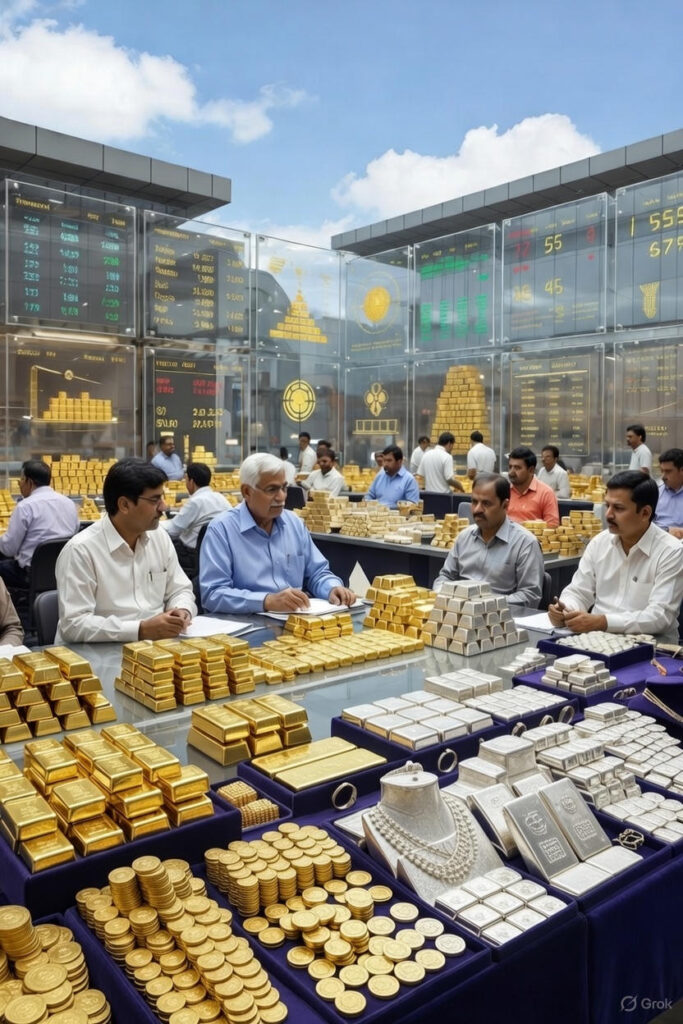
In a significant boost to India’s jewellery export sector, the International Financial Services Centres Authority (IFSCA) issued a key circular on 02.01.2026, expanding access to the India International Bullion Exchange (IIBX) for importing gold and silver. This move relaxes eligibility criteria for Special Economic Zone (SEZ) units and formally includes Advance Authorisation holders, aligning with the government’s push for export-oriented growth. For jewellery exporters grappling with rising raw material costs and complex import procedures, these changes promise streamlined operations, cost savings, and greater competitiveness on the global stage.
At Trade Bridge Advisors LLP, we specialize in navigating such regulatory shifts to help exporters unlock incentives under schemes like SEZ, DGFT, and more. In this article, we’ll break down what IIBX is, the recent amendments, and how they benefit various types of jewellery exporters.
What is the India International Bullion Exchange (IIBX)?
For those unfamiliar, the IIBX is India’s first international bullion exchange, established in the Gujarat International Finance Tec-City (GIFT City) – an International Financial Services Centre (IFSC) in Gandhinagar. Launched by Prime Minister Narendra Modi on in July 2022, and regulated by the IFSCA, IIBX serves as a centralized, transparent platform for trading and importing bullion like gold and silver.
How Does IIBX Function?
IIBX operates like a modern stock exchange but for precious metals. Here’s a quick overview:
- Trading Mechanism: It facilitates spot trading in gold (995 and 999 purity) and silver, with contracts settled through physical delivery or cash. Participants place orders via digital platforms, ensuring efficient price discovery based on global market dynamics. Futures contracts for gold and silver were introduced in mid-2025, providing hedging options.
- Key Stakeholders:
- Qualified Suppliers: Accredited international entities (e.g., from LBMA, COMEX, or SGEI) who supply bullion.
- Qualified Jewellers (QJs): Domestic entities, including exporters, notified by IFSCA to import directly.
- Trading Members: Brokers or intermediaries handling transactions.
- Vault Managers: Secure storage and delivery within IFSC vaults.
- Import Process: Eligible importers (like QJs, SEZ units, and Advance Authorisation holders) buy bullion on IIBX, pay in foreign currency, and handle customs clearance. The exchange issues indicative price documents for remittances, ensuring compliance with RBI and DGFT rules.
- Unique Features:
- Transparency and Efficiency: Real-time pricing reduces dependency on banks or nominated agencies, cutting intermediary fees.
- Duty Benefits: Under agreements like the India-UAE CEPA, importers get a 1% duty concession on UAE-origin gold (UAEGD) via Tariff Rate Quotas (TRQs).
- Global Integration: IIBX connects Indian markets to international hubs, allowing imports in small quantities (as low as 100g of gold), which is ideal for smaller exporters.
- Faster Clearance: Post-trade execution, an in-house Customs Clearance Centre enables swift processing within hours, accelerating access to physical bullion.
Since its inception, IIBX has seen volumes surge from 411 kg in March 2023 to over 67,000 kg by March 2025, driven by CEPA benefits and policy support. It’s not just about imports – IIBX promotes financialization of gold, offering tools like bullion depository receipts for hedging risks.
Key Changes in the January 2026 IFSCA Circular
The new circular (IFSCA-PMTS/10/2023-Precious Metals/2026/1) amends the consolidated framework, based on stakeholder feedback. It broadens participation while easing bottlenecks:
- Relaxed Eligibility for SEZ Units: SEZ units with valid Letters of Approval (LoA) and jewellery exports as an authorized operation now qualify with lower thresholds:
- 35% annual turnover from jewellery-related goods (HS Codes 7113, 7114, 7118) over the last three years and current year.
- Minimum net worth of INR 5 crore (down from INR 15 crore for non-SEZ entities).
- Annual export turnover of at least INR 5 crore in HS Code 7113.
- Inclusion of Advance Authorisation Holders: Entities with valid Advance Authorisations from DGFT can now apply as QJs. Imports must align with their authorisation’s HS codes and be used solely for exports, per the condition sheet.
- Silver Imports Simplified: For silver bars under ITC HS Code 71069221, no QJ notification is required – any entity with a valid IEC can import, subject to RBI rules.
- Compliance Streamlining:
- Continuous monitoring of net worth and turnover on a half-yearly basis.
- Suspension for non-compliance, with denotification after 6 months of inactivity.
- Direct delivery of bullion to SEZ premises post-customs clearance, reducing logistics hassles.
How These Changes Benefit Different Types of Jewellery Exporters
The amendments shift IIBX from a narrow platform to a trade-facilitative ecosystem, directly addressing pain points like high import costs and procedural delays. Here’s how they impact various exporters:
1. SEZ-Based Jewellery Exporters
SEZs, which contribute significantly to India’s $40+ billion annual gems and jewellery exports, now have tailored relaxations. With lower net worth (INR 5 crore) and turnover requirements (35% from jewellery), smaller SEZ units can qualify as QJs.
- Benefits:
- Cost Reduction: Direct imports via IIBX eliminate bank charges (typically 0.5-1%) and agency fees, potentially saving 1-2% on raw material costs.
- Faster Delivery: Bullion delivered straight to SEZ premises, bypassing DTA logistics.
- Export Boost: Meets minimum export turnover (INR 5 crore), aligning with SEZ incentives like duty-free imports.
- Example: A mid-sized SEZ exporter in Surat or Mumbai can now import 1 kg of gold at competitive rates, reducing overall production costs and improving margins on international orders.
2. Advance Authorisation Holders
These exporters, who import duty-free inputs for specific export commitments under DGFT schemes, are now formally integrated into IIBX.
- Benefits:
- Seamless Compliance: Imports tied directly to authorisation HS codes, ensuring audit-proof traceability.
- Flexibility: Participate via Bullion Trading Members, importing only for export purposes – ideal for contract-based exporters.
- Duty Savings: Combined with CEPA’s 1% concession, this lowers effective costs for UAE-sourced gold.
- Example: An exporter with an Advance Authorisation for diamond-studded gold jewellery can import silver bars without QJ hurdles, fulfilling export obligations faster.
3. General Qualified Jewellers and Exporters
For non-SEZ/AA entities, the core eligibility (60% or 90% turnover from Chapter 71 goods, INR 15 crore net worth) remains, but the overall framework eases access.
- Benefits:
- Wider IEC Holder Access: Silver bar imports (HS 71069221) open to all valid IEC holders, democratizing supply for smaller exporters.
- Reduced Raw Material Costs: As highlighted in industry discussions, IIBX’s transparent pricing and direct sourcing cut premiums over traditional channels.
- Risk Mitigation: Hedging via futures contracts protects against price volatility, crucial for exporters with thin margins.
- Global Competitiveness: Access to responsibly sourced bullion enhances appeal in markets like the US and EU, where traceability matters.
Overall, these changes could reduce raw material costs by up to 2-3%, as per stakeholder feedback, by minimizing intermediaries and leveraging CEPA. For India’s gems and jewellery sector – which employs over 5 million and aims for $75 billion exports by 2030 – this means enhanced efficiency and growth.
The Bigger Picture: Sustained Efforts for a Thriving Sector
This initiative reflects the government’s calibrated shift toward an export-aligned bullion market, reinforcing IIBX’s role as India’s gateway for transparent imports. By easing compliance and broadening eligibility, IFSCA is fostering operational clarity, continuous norms, and SEZ-specific delivery mechanisms – all while maintaining safeguards like suspension triggers.
However, success depends on robust implementation. Exporters should ensure timely GST filings, attested certificates, and half-yearly reviews to stay compliant.
At Trade Bridge Advisors, with our deep expertise in SEZ, DGFT, and Export Incentives, we’re here to guide you through these opportunities. Whether it’s applying for QJ notification, optimizing Advance Authorisations, or setting up SEZ operations, our team can simplify the process and maximize benefits.
Ready to leverage IIBX for your exports? Contact us today at info@tradebridgeadvisors.com or visit our website for a consultation.
Stay ahead in the evolving trade landscape!