
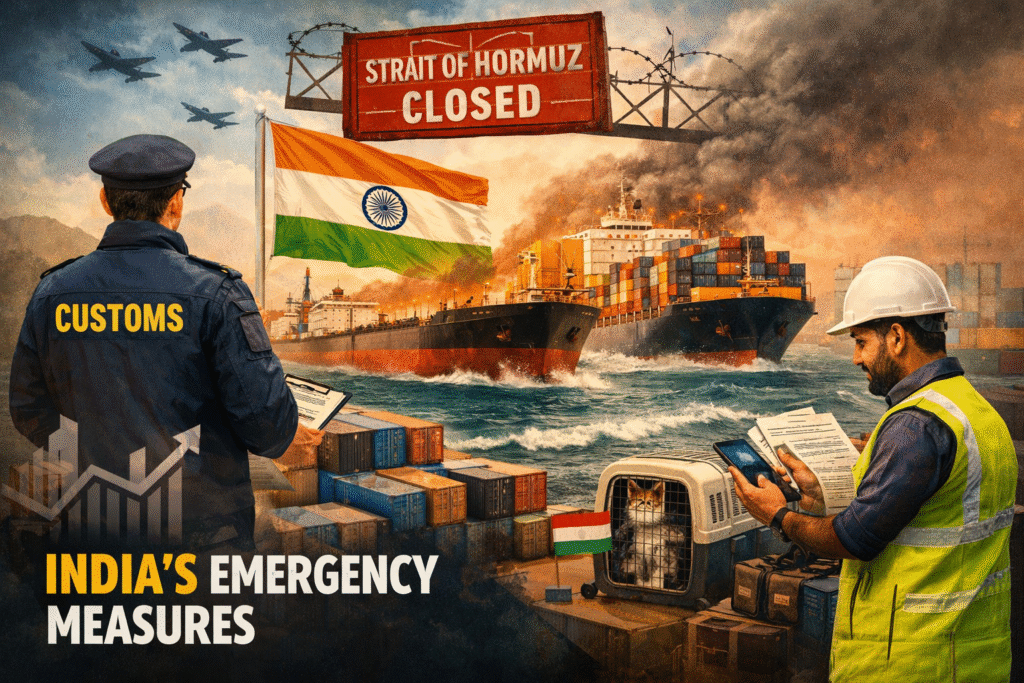
The closure of the Strait of Hormuz — one of the world’s most critical maritime chokepoints — has sent shockwaves through global supply chains. For India, a major trading nation with deep commercial ties to the Gulf, West Asia, and Europe, the disruption has been immediate and acute. Vessels carrying Indian export cargo have been unable to reach their intended destinations. Containers are stranded at gateway ports. Exporters are staring at cascading consequences: cancelled sailings, fee liabilities, and uncertain logistics.
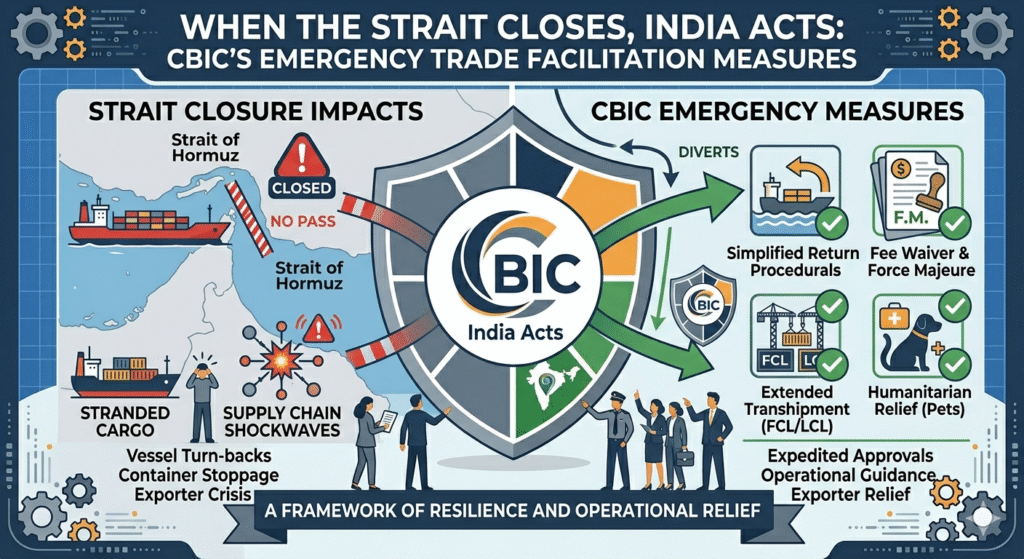
The Central Board of Indirect Taxes and Customs (CBIC), exercising its emergency powers under Section 143AA of the Customs Act, 1962, has responded with a series of targeted circulars — each addressing a distinct dimension of the crisis. Together, they constitute a coherent framework of relief and operational guidance for exporters, shipping lines, customs brokers, and field formations.
This article analyses the circulars issued by CBIC in March 2026, explains what they mean in practice, and identifies action points for trade.
1. Circular No. 09/2026-Customs (08.03.2026)
Subject: Return of Export Cargo from International Waters — Simplified Handling Procedures
This was the opening salvo of CBIC’s response. Field formations had reported that vessels carrying Indian export cargo were being turned back from international waters as a result of the Strait’s closure. The Board stepped in to prescribe a clear, scenario-based handling framework.
The circular creates three procedural tracks, depending on how far the vessel has travelled:
Track A — Vessel within Indian territorial waters, EGM/SDM not filed:
No Sea Arrival Manifest (SAM) is required. The master submits an undertaking that the vessel has not crossed Indian territorial waters. Containers may be offloaded without a Bill of Entry after verification of shipping documents and seal integrity. Shipping Bills and Let Export Orders (LEOs) are to be cancelled. Back to Town (BTT) facility may be granted on request.
Track B — Vessel within Indian territorial waters, EGM/SDM filed, or returning from international waters without calling any foreign port:
SAM filing is again exempted. An undertaking from the master is required. Containers may be offloaded on verification of SDM and related documents. DG Systems is directed to provide a new facility in ICES to cancel Shipping Bills post-EGM. Cancelled Shipping Bills are to be reported to RBI, DGFT, and other agencies via ICEGATE, ensuring export incentives are not erroneously disbursed.
Track C — Vessel returning after calling a foreign port without discharging containers:
Such consignments are treated as exported out of India. SAM must be filed. Procedures from Track B apply thereafter.
2. Circular No. 10/2026-Customs (10.03.2026)
Subject: Waiver of Document Amendment/Cancellation Fees for Force Majeure Cases
When export consignments are withdrawn or rerouted due to the crisis, exporters invariably need to amend or cancel their Shipping Bills and related export documents. Under the Levy of Fees (Customs Documents) Regulations, such amendments attract a prescribed fee. In normal circumstances, this is a reasonable compliance cost. In a force majeure situation, it becomes an inequitable burden.
Circular No. 10/2026-Customs addresses this directly. Exercising powers under sub-clauses (c) and (d) of Section 143AA, the Board has clarified that the Proper Officer may permit amendment or cancellation of export documents without insisting on payment of the prescribed fee, where the amendment or cancellation is necessitated solely by force majeure circumstances.
The circular identifies illustrative force majeure situations, including:
- Cancellation or non-operation of flights
- Withdrawal or rescheduling of vessels
- Disruption of cargo services by carriers
- Closure or operational disruption of ports or airports
- Natural disasters and government-mandated restrictions on transport
The procedure is straightforward: the exporter or authorised Customs Broker submits a request to the jurisdictional Deputy/Assistant Commissioner of Customs, supported by evidence such as airline/shipping line communications or port notices. The Proper Officer, after satisfying himself that the amendment or cancellation arises solely from such circumstances and not from avoidable errors by the exporter, may grant the waiver.
Importantly, the circular applies to all Customs stations — seaports, air cargo complexes, ICDs, and CFSs alike. The relaxation was initially valid for 15 days from issuance; exporters who have paid such fees during this period may wish to explore whether recovery or credit is available.
3. Circular No. 11/2026-Customs (16.03.2026)
Subject: Import of Pet Dogs and Cats Accompanying Stranded Indian Nationals from War-Hit Middle East
While the preceding circulars focused on cargo and trade logistics, Circular No. 11/2026-Customs addresses a humanitarian dimension of the crisis: the evacuation of Indian nationals stranded in war-affected Middle East countries.
The CBIC circular gives effect to an Office Memorandum dated 12 March 2026 issued by the Department of Animal Husbandry and Dairying (DAHD), Ministry of Fisheries, Animal Husbandry and Dairying. Given the extraordinary circumstances, pre-export formalities for pets — which are ordinarily required under the Livestock Importation Act, 1898 — may be impossible to fulfil from a conflict zone.
The DAHD has accordingly introduced a one-time relaxation. Pre-import conditions include:
- A declaration from the owner confirming that the pet has been residing with them for at least one month
- Submission of vaccination certificate, pet book, or pet passport (including where vaccinations are due or delayed)
- Where the pet was retrieved from a neighbouring country, a veterinary check from that country’s authorities if available
Post-import, the Animal Quarantine and Certification Services (AQCS) will conduct document examination and clinical examination at the port of entry. If the last vaccination is more than 15 days overdue, or if no vaccination certificate exists, the pet will be vaccinated for rabies at the owner’s cost at the port of entry before AQCS clearance is granted.
In cases of abnormal clinical findings, quarantine will be required, with all costs borne by the owner.
4. Circular No. 12/2026-Customs (17.03.2026)
Subject: Supplementary Procedures for Cargo Returning to a Different Indian Port
Circular No. 09/2026 had prescribed procedures for vessels returning to their port of departure. A lacuna emerged: what if a vessel, for operational reasons, berthed at a different Indian port from the one it originally departed? Field formations sought guidance, as did trade, on the procedures for transhipment and Back to Town (BTT) in such cases.
Circular No. 12/2026-Customs fills this gap. The key elements are:
Where the vessel departed from any Indian port and lands at a different Indian port:
The Shipping Line or its authorised agent must file the Sea Arrival Manifest (SAM) at the port of landing. DG Systems will provide a dummy port code for vessels returning to India without calling any foreign port. Discharged containers are verified by the Proper Officer against the SAM and related documents. Seal integrity is checked. On the exporter’s request, the Customs formation at the port of landing coordinates with the port of export to verify incentive disbursements and to cancel the Shipping Bill and LEO. BTT is permitted after verification and confirmation.
International Transhipment from the returning vessel:
Taking reference from CBIC Circular No. 14/2007-Cus (which originally permitted international transhipment of LCL cargo only at Cochin, Chennai, Tuticorin, and Nava Sheva), the Board extended the facility to permit international transhipment of LCL cargo from all notified ports and International Airports until 31 March 2026. The Pr. Chief Commissioner/Chief Commissioner of the respective zone was empowered to extend this facility based on infrastructure availability.
Liquid Bulk/Break Bulk Cargo:
A specific provision addresses vessels carrying liquid bulk or break bulk cargo destined for foreign ports which are compelled to divert to an Indian port. The jurisdictional Principal Commissioner/Commissioner of Customs may permit temporary unloading and storage within a Customs area or Customs-approved bonded warehouse or bonded tank facility, for the limited purpose of onward international transhipment or re-export. Such permission is case-specific and subject to full Customs supervision, proper inventory maintenance, execution of a bond or undertaking, and ensuring that cargo remains under Customs control and is not cleared for domestic consumption.
The relaxation under Circular No. 12/2026 — and those under Circulars No. 09 and 10 — were initially valid until 31 March 2026.
5. Circular No. 15/2026-Customs (27.03.2026)
Subject: International Transhipment of FCL/LCL Cargo from All Ports/Airports — Extended and Systematized
By late March, it was evident that the disruption would not resolve quickly. Trade representations poured in seeking a formal extension and expansion of the transhipment facility introduced under Circular No. 12/2026. Specifically, the trade sought extension of the facility to Full Container Load (FCL) cargo as well (Circular No. 12 had addressed only LCL), a uniform and simplified approval procedure across all Customs zones, and clear guidance for cases involving movement through multiple Customs stations.
Key features of Circular No. 15/2026-Customs:
FCL and LCL — both categories, all ports:
International transshipment of both FCL and LCL cargo is now permitted from all seaports and international airports, including cases involving transhipment through other Customs stations.
Nodal Officers:
Each Customs Zone must designate a Nodal Officer of not below the rank of Additional Commissioner or Joint Commissioner of Customs for expeditious processing and supervision of transhipment requests.
Multi-station transhipment:
Where transhipment involves movement of cargo to another Customs station for onward transhipment, a prior consent mechanism through official email between Nodal Officers applies. The Nodal Officer at the transit/destination station conveys consent after verifying availability of adequate storage space, infrastructure, and logistics support. Movement takes place under Customs control, including sealing of containers where required.
ICD cargo at gateway ports:
A specific concern addressed is export cargo originally cleared at ICDs which is lying at gateway ports on account of the disruption. On the exporter’s request, the originating ICD may cancel the LEO/Shipping Bill. The Customs officer at the gateway port may then allow movement of such cargo out of the port for return to the exporter or re-routing, without the need to bring containers back to the originating ICD.
Bangladesh cargo transiting through Indian ports:
The circular acknowledges representations received regarding cargo moving from Bangladesh via Kolkata/Mumbai and currently lying at JNPT, requiring temporary facilitation for onward movement through Mumbai Airport. This issue is stated to be under examination by the Board.
SCMTR 2018 — a nudge towards systemic reform:
Notably, Circular No. 15/2026 draws attention to the Sea Cargo Manifest and Transhipment Regulations, 2018 (SCMTR), which provide a comprehensive framework for electronic filing and processing of cargo manifests and transhipment operations. The Board observes that SCMTR implementation has remained deferred, and urges all zones and DG Systems to expedite its operationalisation, specifically citing the present crisis as a demonstration of why supply chain resilience infrastructure matters.
The facility under Circular No. 15/2026, along with the relaxation timeline from Circular No. 12/2026, has been extended until 15 April 2026.
What This Means for Trade
Taken together, these circulars establish a multi-layered framework that addresses the crisis across several dimensions:
- Exporters with cargo on diverted or returning vessels have a clear legal basis to seek cancellation of Shipping Bills without fee liability.
- Customs brokers handling such consignments should immediately compile supporting documentation — shipping line communications, port notices, vessel undertakings — and file applications before the jurisdictional Deputy/Assistant Commissioner without delay.
- Where export incentives (IGST refund, drawback) have already been disbursed, field formations are mandated to recover them. Exporters should be prepared for this and should proactively coordinate with their banks and ICEGATE.
- Freight forwarders and CHAs managing cargo at gateway ports that originated from ICDs should note that the originating ICD may cancel the LEO/Shipping Bill remotely, and containers need not travel back to the ICD.
- The designation of Nodal Officers at each Customs Zone for transhipment approvals creates a single point of contact that trade should identify and engage with early.
- The extended deadline of 15 April 2026 for the transhipment facility provides a working window, but trade should not assume further extensions are automatic.
For exporters, shipping lines, and customs brokers, the immediate priority is operational: identify affected consignments, compile evidence of force majeure, and engage with the Nodal Officers and jurisdictional formations without delay. The legal framework for relief is now firmly in place.