
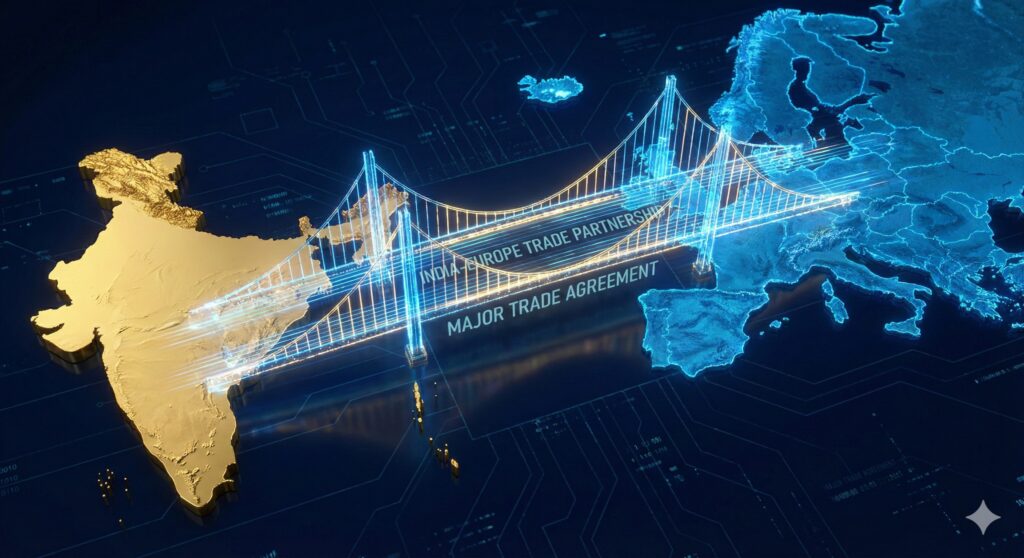
January 2026 Update: India and the European Union have successfully concluded negotiations on their long-awaited Free Trade Agreement (FTA). Often dubbed the “mother of all deals,” this landmark pact marks a major milestone after years of intensive discussions.
Key Takeaways
- Status: Negotiations concluded Jan 2026; implementation expected 2027.
- Tariffs: Duties removed on >90% of industrial goods.
- Urgency: GSP benefits withdrawn effective Jan 1, 2026, creating an immediate tariff gap.
- Opportunity: European firms can leverage the new Investment Protection Agreement (IPA) for safer FDI in India.
At Trade Bridge Advisors, we monitor these policy shifts to help clients stay ahead. As experts in regulatory consulting and compliance, we assist foreign investors entering India with end-to-end support in SEZ approvals, EOU structuring, and DGFT compliance.
This evolving FTA landscape is the perfect time to transform regulatory complexities into competitive advantages.

Core Elements of the India-EU FTA
The agreement focuses on liberalizing trade in goods and services while addressing key rules to facilitate smoother bilateral exchanges. With the formal announcement imminent, the pact is confirmed to include:
- Tariff Elimination: Removal or significant reduction of tariffs on over 90% of traded goods.
- Sector-Specific Cuts:
- For India: Reduced duties on EU automobiles (from >100% to ~40%), wines, and spirits.
- For EU Markets: Zero-duty access for Indian textiles, leather, footwear, gems, and jewelry.
- Sensitive Sectors Protected: India has successfully negotiated the exclusion of sensitive sectors like agriculture and dairy to protect domestic interests.
- Services & Investment: Expanded access for professionals in telecommunications and transport, alongside a dedicated Investment Protection Agreement (IPA).
The “GSP Gap”: Why Indian Exporters Need to Act Now
A critical development for exporters is the EU’s withdrawal of Generalized System of Preferences (GSP) benefits for India, effective January 1, 2026. This creates a challenging “gap period” where tariffs may rise before the FTA is fully implemented (likely in 2027).
Indian exporters in textiles, chemicals, and engineering must act immediately.
Companies leveraging schemes such as SEZ (Special Economic Zones), EOU, or MOOWR can mitigate these temporary costs through operational incentives. Trade Bridge Advisors specializes in optimizing these structures to maintain your competitive pricing during this transition.
Opportunities for Foreign Investors (FDI)
The FTA aligns perfectly with the “China Plus One” strategy, encouraging a surge in European Direct Investment into India. Enhanced provisions for investment protection make India an attractive destination for long-term commitments.
What foreign entities can expect:
- Reduced Entry Barriers: Clearer pathways for establishing operations.
- Strategic Partnerships: Opportunities for Joint Ventures (JVs) in high-growth areas like Green Hydrogen, Automobiles, and Pharmaceuticals.
- Regulatory Certainty: Stronger safeguards against unfair treatment, supporting confidence in scaling presence.
The Edge for Early Adopters
Businesses that move quickly will capture advantages before widespread implementation increases competition. To gain first-mover momentum, we recommend:
- Early Alignment: Review forthcoming tariff schedules and compliance requirements now.
- Strategic Setup: Proactively set up structures like FTWZs (Free Trade Warehousing Zones) to maximize duty benefits.
Regulatory Readiness: Build the internal capacity to claim advantages swiftly.
Frequently Asked Questions (FAQ)
While negotiations concluded in January 2026, the legal review and ratification process means full implementation is expected by 2027.
Generally, no. Sensitive sectors like agriculture and dairy have been excluded to protect Indian farmers.
With GSP benefits ending on Jan 1, 2026, your exports to the EU may face higher standard tariffs until the FTA comes into force. We recommend auditing your supply chain immediately to find alternative incentives.
How Trade Bridge Advisors Can Help
Navigating the new India-EU trade corridor requires expert guidance, especially with the shifting sands of GSP and new FTA rules. Our team draws on decades of specialized experience in India’s trade ecosystem, providing full-spectrum assistance—from licensing and audits to ministry-level advocacy.
Ready to capitalize on the India-EU FTA? Reach out to us at Contact Us to explore tailored strategies for your business.
Disclaimer: Policy details are based on the latest available information as of January 2026 and are subject to final legal text ratification.